faq header  

Tipis

What Size Tipi is Right?

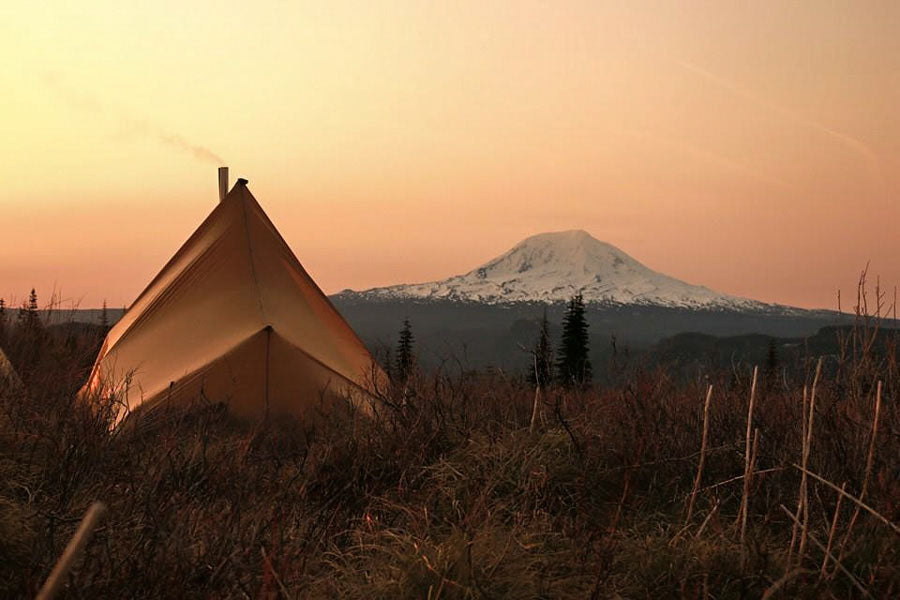
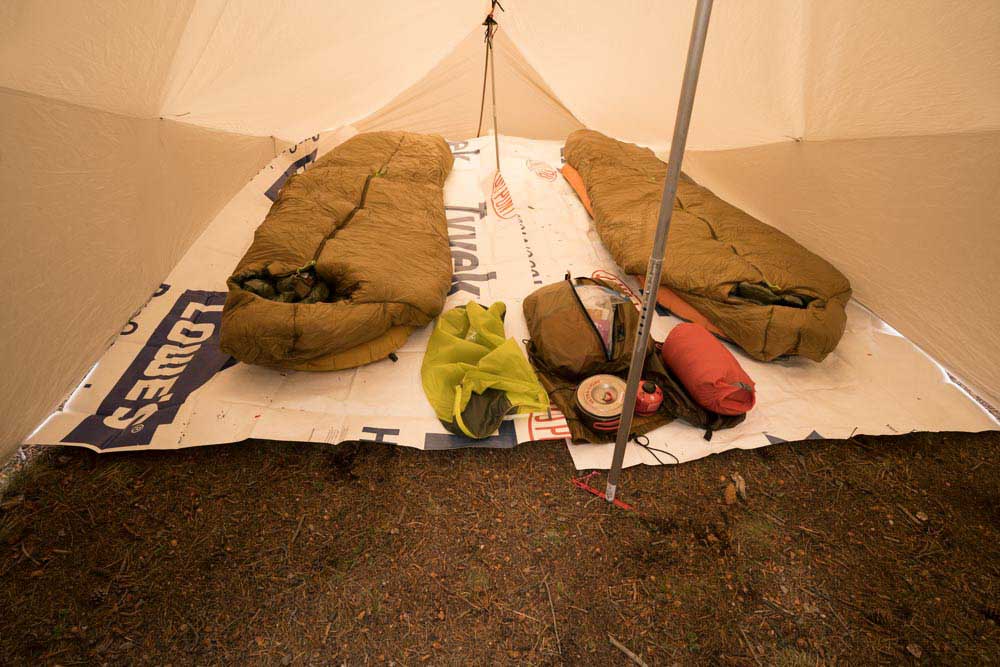
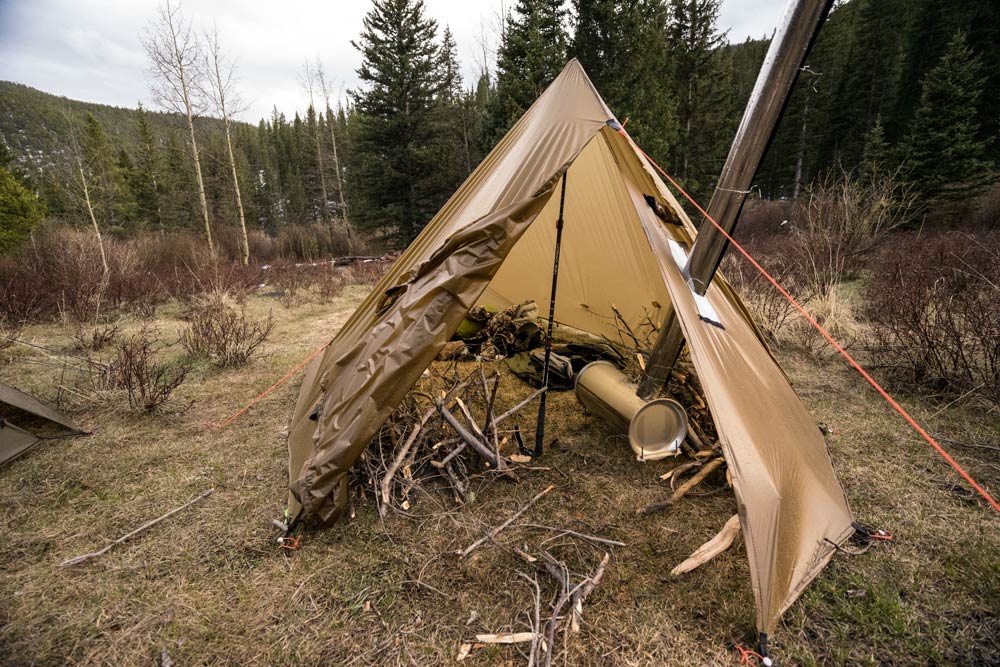
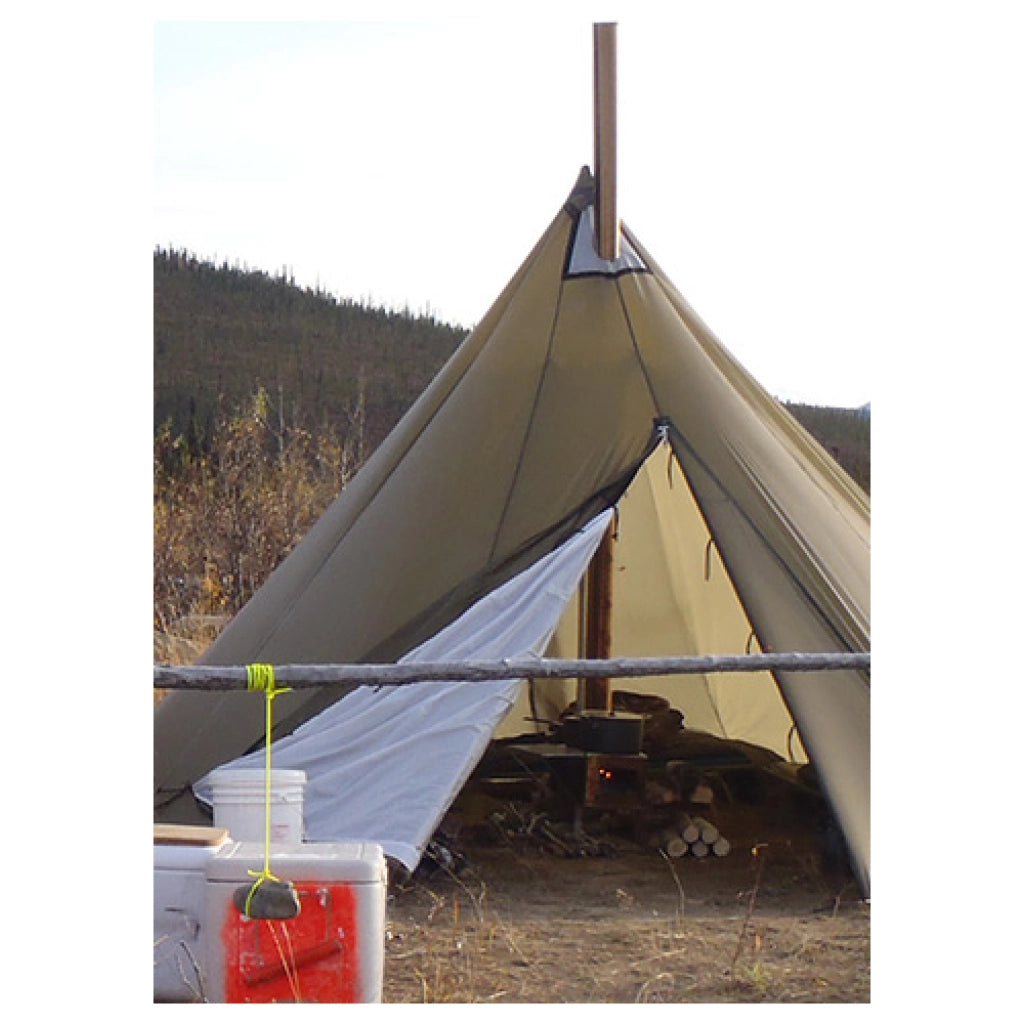
Like all tents, the size of ours is calculated by the number of people it can sleep in the "footprint". Thus, a 4 Man can sleep 4 people quite comfortably and still have room for gear - even with a stove.

  We pride ourselves on "living space" and plenty of standing room. For just hanging out, a 4 Man would be a bit small for 4 people - in fact, it is ideal for two, plus a dog and gear. Likewise, an 8 man Tipi can sleep 8 folks, but is more comfortable for just 4.

  So, the size of Tipi largely depends on your style of camping. Never there? A smaller Tipi might be just right for you. If you camp where there's a lot of bad weather and want to get a card game going, larger might be better.

  A good way to judge Tipi size  is to take some masking tape, and map out the footprint on your living room floor, using the dimensions provided in the Tipi specs of this website.  Since your gear is tucked into the far reaches at the hem, you still have lots of  stand up room.

 Head room: Measure UP from the center to calculate your head room - remembering the sloping roof.  Typically, a 4 Man Tipi gives the average 5'10"  person plenty of stand up room to get dressed.

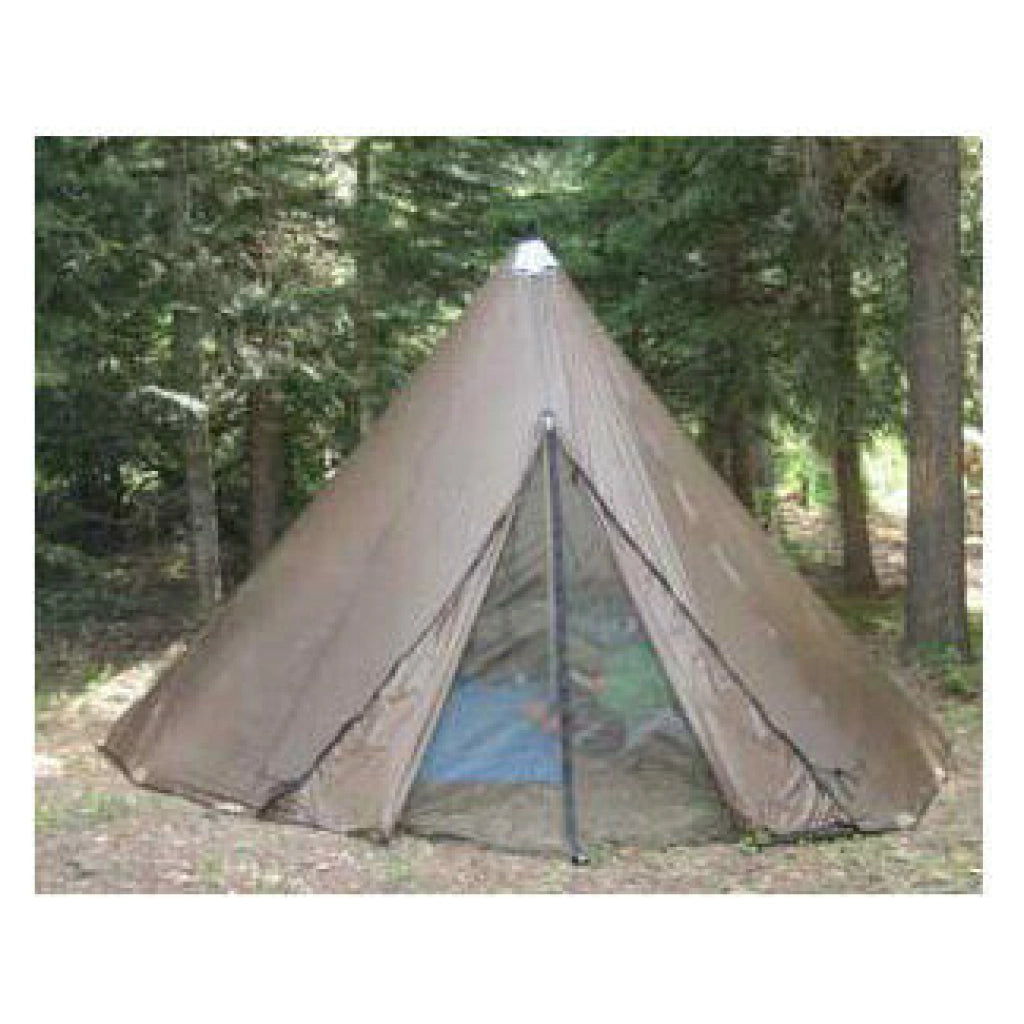
Why Are They Floorless?
Over the years, we have sold many Tipis, with and without floors. The vast majority of users report that we're absolutely right about the advantages of floorless tents.
- Weight and bulk savings
- Lets you walk right into your tipi
without having to remove boots.
- No puddling that later runs into your sleeping bag.
- The Pitch: w
e have built floors in times past, but they were not physically connected to the tipi skin; rather, they were discs that stopped about five inches from the perimeter--to eliminate any possibilty of rain water entering and puddling on the floor. I don't think we can produce a sewn-in, or even velcro-in floor because folks pitch their tipis a little differently and because it's very difficult (probably impossible) for us to sew every tipi such that the huge perimeter comes out exactly the same (in order to "match" a sewn-in floor when the whole she-bang is pitched.) Getting a drum-tight pitch on our tipis is key to their wind-proofness. A restricting sewn-in floor is anathema to that! In part, this is because of varying terrain--which results in a slightly different pitch configuration each time.  The Old Timer's Experience: tents have only had hermetically sealed floors the past 40 or 50 years. Yet people camped in floorless tents for thousands of years in the same country. This includes the prospectors; and I've never heard a story of any of them actually getting nailed by vermin. Have you? "Empty your boots in the morning" is as far as it actually goes. And still good advice!
What about condensation?

Yes, you will get some condensation if you frequent somewhat humid areas. Any brand of lightweight shelter will be offered as a single wall in order to cut weight and bulk.

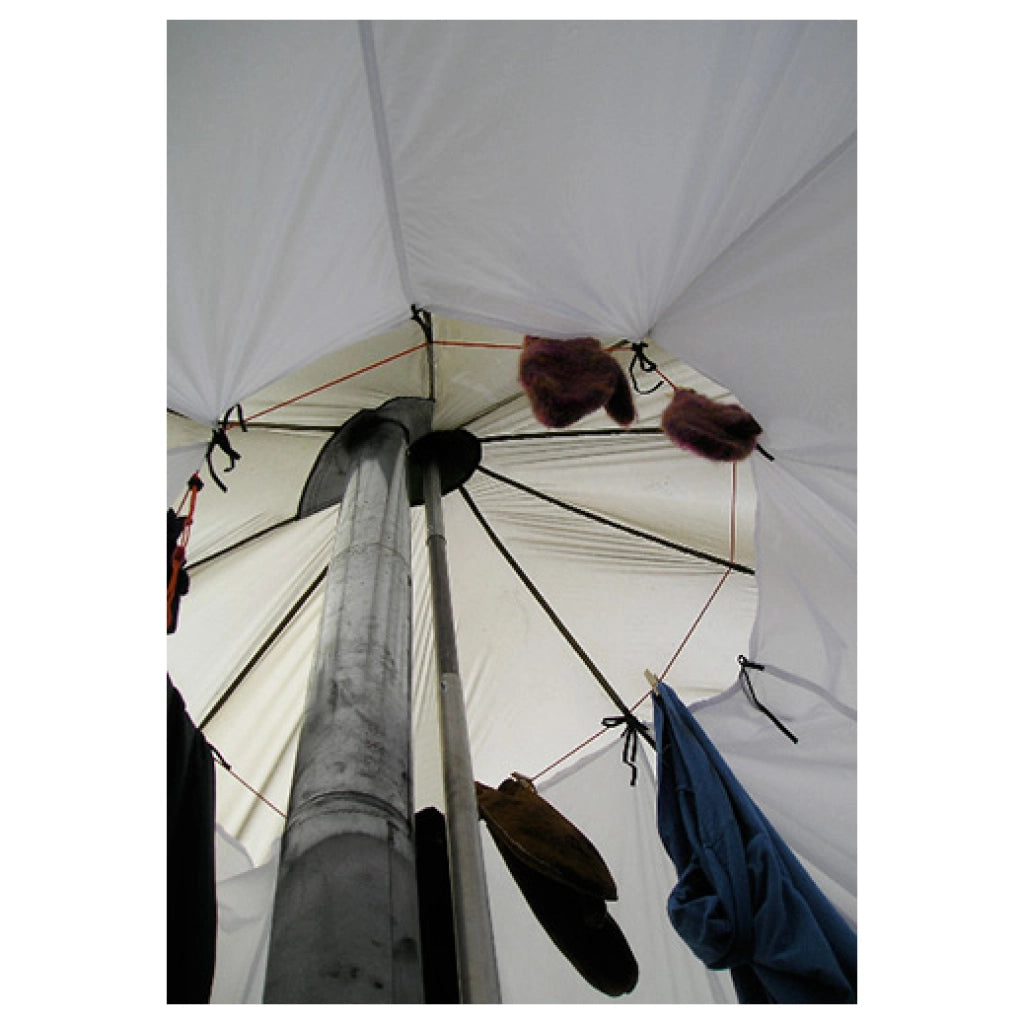
We are the only manufacturer to offer liners are an option. The use of our wood burning stoves will also make a dramatic difference in the "dryness" of your shelter.

The advantage of our Tipis is that they are big and conical, so the chances of you brushing up against the sides is pretty small. Just be aware of that if you're stacking gear against the sides.
 

Excerpt from Wild Sheep Magazine, Winter 2002-03
"The tipi is constructed of totally waterproof material so condensation will occur. I found that by leaving one of the entrance zippers partly open, along with leaving the stovepipe jack open condensation drops to a minimum. I found that sleeping in the tipi even though there was condensation that I remained nice and dry."

How do I set up a Tipi in the wind?
When you've established the set-backs, and staked the four pegs for that, do this before raising the canopy: pull out all the other peg loops, all the way around the canopy, but only "slightly taut", and peg them in, driving the pegs only far enough in to hold temporarily. Then go inside and insert the center pole and start to raise the canopy. You'll find the raising process a LOT more "doable" because you've already established an oval presentation to the wind instead of only a 4-point presentation. Not a "finished" presentation, but an "intermediate" one that helps immensely in getting the canopy up to full height whether you're alone in pitching, or even if you have helpers. You'll find that you can raise the center pole higher, and much more easily, if you take this intermediate step in wind conditions. When you've raised the center pole as high as you can, exit the canopy, zipping the door behind you, and then pull the "temporary" pegs out further, as you would "normally", and drive them home. You're now set for anything the wind can deliver.

For years and years we've received accounts of these tipis of ours standing up to winds that flattened every mountaineering tent in the vicinity; folks crowding into our tipis from jumping-off-to-the-summit benches in the Andes/Himalayas/etc., etc., when the famous brand mountaineering tents in the area collapsed. This, without benefit of the tip I've just laid out to you readers. One has to think the purveyors of these testimonials pitched their tipis whilst the wind was blowing.

The key is anchoring ALL the pegs out far enough to make raising the center pole more effective, but not too far so as to restrict doing that; then pulling 'em out full-taut and driving 'em home.
How do Tipis handle the wind?

I've experienced it under typical sustained winds. I do know that these things have held up great (when all other tents have been flattened) under gale force winds. These have been in places like the Antarctic and Mt. Everest where the winds are legendary. Here's why:
1. The conical shape has no big flat sides to catch wind (or snow), so it swirls around it, and not against it.
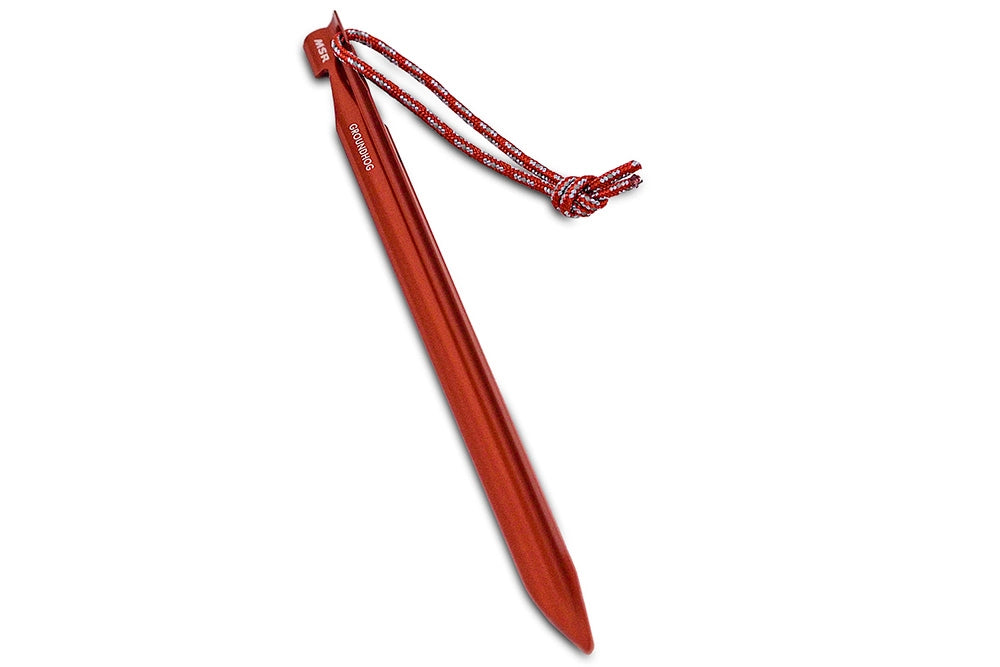
2. The Tipis come with our "Dura Pegs" - made from plastic. For the prairie, I prefer our Snow and Sand stakes. These monsters are long (18 inches) and metal, and you can drive them in for a really solid stakedown. That thing's not going to budge. Now, these stakes combined with the centerpole, easily replace the need for any guy wires. We do not have them. Therefore, nothing to trip over.
3. Lastly, being floorless, the wind cannot catch an edge of the bottom and flip the tent, like so many pop-up tents. I recently read of a river runner who was canoe camping. He and his 4 year old were tending the fire when a huge gust came out of a slot canyon, caught their pop-up tent and blew the whole thing into the river, and promptly sank. The gear inside easily outweighed his kid, and had the kid not been outside, HE would have been at the bottom of the river. Anyhow, off track. Sorry. But you can see another advantage to a floorless shelter.

From our long time users

" I left the tipi up continuously for nine months. There was no apparent fabric deterioration from the sun. It withstood all nature could throw at it including several very strong winds to 75 m.p.h. One high wind did blow down our regular 16 foot Indian tipi."
Duncan Gilchrist, Wild Sheep Magazine


"Our outfitting area is a high, ridge top trail that is often subject to heavy winds and weather and operating a kitchen for my guests under those conditions was always tough until I discovered the tipi which has been our cooktent and gathering place every night since."
Sincerely,
Steve Rolfing, Great Northern Lama Company (tipi owner for 13 years)
 

Tibet is one of the windiest places on earth. I'm not surprised they (our crew) decided to use the Kifaru Tipi, its often close to impossible to set up other types of tents in the strong winds. At Everest Base Camp the Tipi demonstrated an exceptional ability to shed snow and withstand tremendous winds. Believe me when I tell you there is plenty of wind and snow at Mt. Everest ... the Tipi remained remarkably stable when other large tents in nearby camps collapsed.
Thanks, Scott
Expedition Leader, E3

I  wanted to let you know that during the last full moon I was using the Tipi with some clients when we got POUNDED with wind.That trip ended any question about how the Tipi would stand up to high winds.The snow pegs never budged!
Take care. Steve"
Steve Pitts, Adventures Made Easy

"The eight sided tent efficiently spills wind. I've had it survive measured winds of 50 mph. The #10 zipper is extremely strong and opens from bottom and top. Extra guys higher up the tent walls add stability in extreme winds..."
Couloir Magazine

From our Message Boards

I've spent a couple of nights laying there listening to trees crashing down all around me, but my 8 man never budged.
Ken, New York
___________________________
I had an 8 man pitched for over a month steady doing stove burn tests. It weathered a number of sustained winds of 85 MPH with gusts of 98-103 MPH. These were all measured using a Brunton wind meter. The tipi came thru as good as new.

Believe me, those are some horrid winds. You have to fight to stand up and it will actually prevent you from breathing without creating a wind break with your hand.

I have had the 8, 12 and 4 man tipi's in similar conditions when hunting and backpacking, just didn't have the wind meter along to verify.

Ed T , Helena, MT
________________________________________________
I frequently hunt on Kodiak Island. It gets windy.
This year we had 3 days that were too windy for small planes to fly (typically the airtaxis quit flying somewhere between 30mph & 40mph). I know that the wind at night was much stronger than the daytime winds. Absolutely no problems.
A couple of years ago I camped on top of almost solid stone. I don't think I was able to fully seat any of my tent stakes (broke 2 of my tundra stakes, then quit trying to pound them past the HARD point). The 2nd night out, the wind could only be described as ferocious and I spent most of the night with my hand clamped on some loose fabric at one of the doors. According to our air taxi, winds were measured at gusting over 87 mph. No problems (other than lost sleep).
There are other tents that may be able to handle the wind like my 8 man tipi does, but at quite a weight penalty.
I'm quite happy with the tipi and the only change I may someday make is to get a 12 or 16 man.
Gary, Anchorage
______________________________________________
Had my 8 man out last winter in a full on blizzard. Snowed 2-3 feet on us and gale force winds. In fact woke my buddies up worried about the whole thing and they basically told me to shut up and go back to bed. Worked out ok and had great skiing the next day.
DanH, Missoula
____________________________________________
I was in my paratipi in 85 mph sustained winds and rain for 60+ hours on the Alaskan tundra. I have no worries at all about their strength.

Dean, Long Island

_____________________________

I had an 8 man pitched for over a month steady
doing stove burn tests. It weathered a number
of sustained winds of 85 MPH with gusts of 98-103 MPH.
These were all measured using a Brunton wind meter.
The tipi came thru as good as new.
Believe me, those are some horrid winds.
You have to fight to stand ...
I have had the 8, 12 and 4 man tipi's in
similar conditions when hunting and backpacking.

Ed T, Helena MT
How do Tipis handle snow?
Again, the shape helps shed snow quite well. Depending on your geography, out in the flats, you should have virtually no build up. If you are pitched in an area where snow might accumulate (tree well, hollow, etc.) you may have to occasionally brush off a big accumulation. The Tipi, however, will not collapse. I'm going to let Patrick give you specifics on this part as well, as I've never measured amounts or rate of snowfall.
Snow Melt.
The hem of the fabric is quite snug to the ground,as the pegs drive in the anchor points below ground level, unless you're in rocks. This will keep out most moisture, wind, dust. Snow melt or heavy sustained rains you may have moisture encroach to a maximum of about 5 inches into the Tipi footprint. The ground absorbs nearly all of it, and water simply does not "sheet" under the Tipi. This leaves the vast majority of your footprint dry.
How Do Tipis handle rain?
Rain is not a problem. Please do be aware that in order to save weight, we do not have a dew cloth, so you may get some condensation inside, but that has never really been a problem for most folks, as you stand away from the walls anyhow. With our long pegs, the anchor points are actually driven in at below ground level, pulling the hem taut with the ground surface. In a long sustained downpour, you may get moisture encroaching to about 4-5 inches into the diameter, but that's it - the ground does all the absorbing, and water simply does not "sheet" in under the tipi.
What About Cinder Holes?
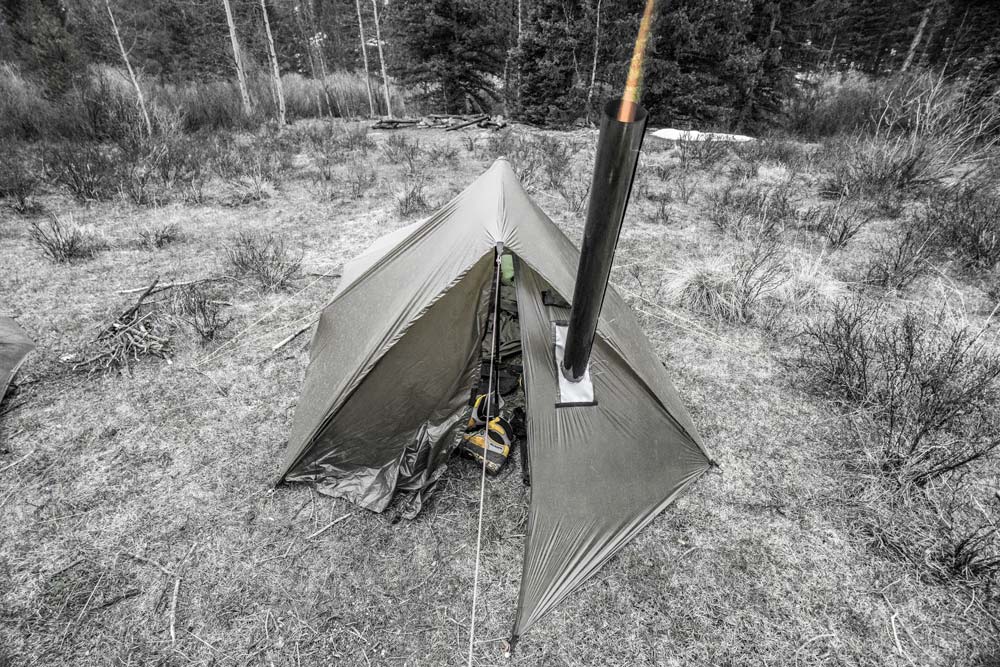
Cinder holes are rare because we provide two cinder screens in the stove pipes to filter out most of the floaters. You can take these out and clean them, or use only one depending on your fuel source. Greasewood does fine, and you simply need to check your cinder screens once in a while. I've burned cow pies numerous times on my trips, and they do great! They had surprising long burn times, and I usually throw a couple of those in just before bedtime. I've never noticed any gumming of the cinder screens, nor any odor (these are high quality pies, I might add - good Colorado cattle).

If you do get a pinhole, simply seal it up with the ShooGoo that we provide.

What about long term setup?
Any nylon structure will suffer from UV rays if allowed to remain erected for prolonged periods of time. We strongly recommend NOT using your Kifaru shelter as a permanent structure.
Why are there no zipper flaps?

The tipis get used all year round.  For winter rime-up conditions we simply cannot use a flap: it'll seal off air intake.  So we purposefully leave the zipper teeth exposed for that very reason.  Remember, there's always a stove in there with our tipis.  Safety issue, and a very real one.   Thus, there has to be a compromise.  In summer, just rearrange sleeping/sitting array so that nobody is underneath the zippers during those real pelting rains.   Nobody can die in one of our tipis.


Stoves

Why is there no damper?
Not offering a damper is a safety measure...few people know how to use them nowadays, backcountry wood covers all degrees of wetness etc. and a damper set too "closed" can and will begin to smoke after a tired camper has drifted off to sleep, with dire consequences. The stoves have excellent draft therefore and one controls output by how much fuel is put in...rather like an open campfire, but in a very safe box.
Why stainless steel instead of titanium?
Our stove weights are very close to Ti at considerable cost saving; Ti is not good at curling like our stovepipes have to do.
Does snow melt inside the shelter with the stove going?
No. It gets a kind of crust on the surface that’s great for walking on. There are no puddles or mush you sink down into at all. It’s pretty neat. And you can still dump a stale pot of coffee next to the stove and it sinks right in right there. If you’re snow-bound you can go to the bathroom on one side of the tipi, and scoop up pots full of snow on the other side for melting on the stove. I’m talking about inside the tipi. Just don’t forget which side is which, folks.
How warm can the Tipi get with the stove going?
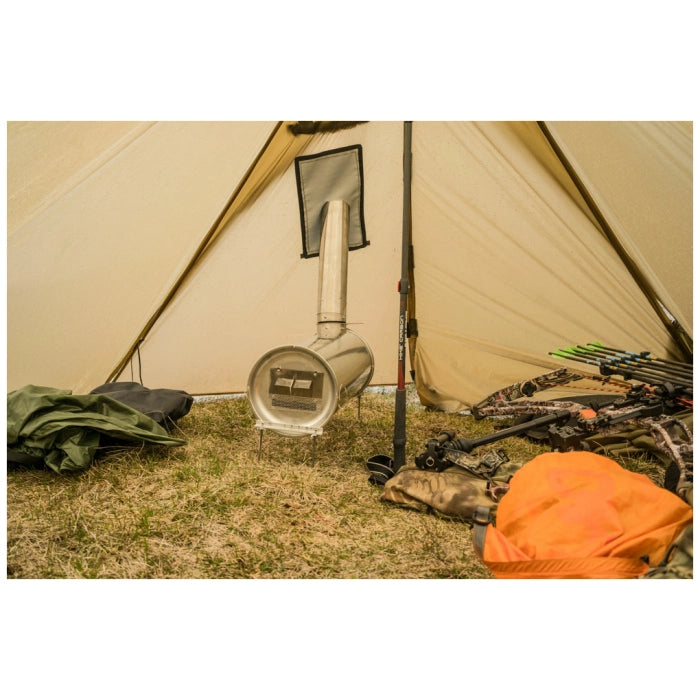
Probably the most precise answer is to cite my experience of "snow bathing" in an 8 man tent some years back. (See below.) By feeding the stove finger- size sticks (not all at once – which will cause the stove to "cough" smoke back into the tipi) I elevated the inside temperature of the tipi 120 degrees F. above the outside temperature. So let’s say that a "normal" (i.e., big wood in the stove box too) serious fire in the large stove will warm the 8-man tipi 100° F. above the outside temperature. That’s a bit conservative, but let’s go with that. I know that the small stove in the 4-man tipi will do at least as well. With the 12-man tipi, let’s say 75° , to be conservative. And that is why the 12-man tipi has two stovepipe openings. Say you’re in Alaska and the outside temperature is 50 below. Inside, you’re still below freezing with only one stove! Solution: when you expect seriously low temperatures you can use two of our stoves in the big tent and still get the inside environment up to room temperature! You’ll have a lot more cooking/snow-melting surface too.

By the way, both tipi doors can be opened in a wedge-shape to spill heat very quickly in the event you get too hot inside the tent. And I’m not kidding when I say this will happen. The new stoves probably have a bit more range, actually, because they have 9" vs. the old 6" firebox depth which allows for a better burn. I hope this discussion has given you a pretty good idea of "range" as far as low temperatures are concerned.

Message Board Comment:
I just read an article on Kifaru in backpacker magazine, I think it was an old one, anyway they said something like if it was 0 outside that they could get the temperature up to forty degrees inside the 4 man tipi. If I remember right doesn't say the large stove in the 8 man tipi get it warmer than that. Just wondering, I would hope it would warm it up more that that. Input is appreciated thanks.
TJW

Message Board Comment
Just last week, I recorded the temp of an 8 man with a large stove at 130 at the clothsline and 84 at two feet above ground. This was a good hot fire but nothing compared to a fire Patrick & I had going back in October.

" These things are designed for full-tilt usage. In any event, the medium stove in a 4 man tipi will raise the inside temperature of the tipi at least 100 degrees. "
Patrick


Will the stove melt into the snow?
It sure will! That’s why you have to have our stove platform if you’re going to camp on top of snow. It also holds up the tipi’s center pole, which would sink out of site in a hurry too! You can cobble your own stove/center pole platform out of a cookie sheet, but the one we build has "locaters" for all four stove legs as well as the center pole. It also has a "cleat" on the bottom for anchoring it to the snow. Believe me, when a 75 mph wind is whacking the side of your tipi you’ll thoroughly appreciate having the been-there, done-that "official" version!
Has the bottom ever burnt through?
No stove has EVER "burned through" for ANY reason. Nor with any fuel. Can't be done. Our stainless is impervious to everything it seems.
Can I use a Duraflame or charcoal?
Duraflame or Presto logs. First, the disclaimer. The makers of these logs will state on their packaging that the logs are not to be used in a closed environment, such as a stove as ours. To do so, you assume whatever risk the manufacturer seems to have with it. We have tried these, and yes, they work, but we find that they are a pain to chop up, produce an inadequate heat, and leave a  residue on the inside of your stove - as the  logs are usually sawdust held together with wax of some sort.

Charcoal. Our own trials, and those of other stove owners, have found no ill effects of using charcoal. We have yet to burn through the bottom of a Kifaru stove, and the draft is good enough not to produce fumes with such fuels.

How about desert camping?
The tents work great in the desert! By driving the pegs down below ground level you pull the tipi skirt firmly against the soil, thus blocking blowing sand. Mid-day in the desert is when you’ll be able to use the tipi’s "awning" feature – rolling up the whole bottom edge and opening the twin doors all the way creates a terrific sun-shade. One of the best times I’ve ever had in one of my tipis was in southern Nevada. At night I would batten everything back down and fire up the stove, burning whatever that weird wood was (never did find out). Gets cold out there at night! I’ve camped down in Arizona a lot too. Never have had a critter threaten me or get me because I wasn’t in a "baggie" shelter. The prospectors and Indians seemed to have survived too. Use 40-penny nails if you encounter desert "hard-pan" soil.
What about fire retardancy?
The standard weight tipis do have flame retardant fabric. Alas, the ultralites do not--can't put retardent stuff on it and get waterproofness. After eight years of using my paratipi predecessor and a couple of years of burning verything I could find at full bore in the larger tipis--WITHOUT SCREENS--I am confident they won't go poof. The prototypes have many cinder holes. Patrick

A.  Hi Paul, I am a new 4 man tipi and med stove owner. When I first set them up in my yard I fired off the stove and in no time I had the flames shooting out the top of the stove pipe several inches. This was with no spark screens in place because I was using very dry sticks. I watched closely for sparks but did not see any but I can say that the safety fabric around the stove pipe hole is very heat resistant! I'm still amazed that I can hold a 4 man tent (that I can stand in) and a stove, pipe, etc. IN ONE HAND. You guys that have not seen the new stove pipe, imagine this: the entire pipe when stored is the size of an empty paper towel roll! My kids and I lounged around in the tent all evening in our shirt sleeves with 20 deg.F outside. By that time the fire had calmed down and we fed it just a small amount of wood to keep it toastey inside. KIFARU IS AWSOME Thanks Patrick, AK DAVID

What does it burn, and what is burn time?
Designed to efficiently burn small, easily gathered and hand-broken dead wood (no need for a saw or axe). They will work with twisted grass, dried peat or even cow pies.
Burn time depends entirely on your fuel - obviously, harder woods will give you a longer burn time. The larger stoves will let you add more fuel and thus, burn longer.